Nov. 23rd, 2016

caitri: (bullshit)
I've been doing a lot of contemplating these last two weeks, while also trying to do keep my head above water with school and deadlines and all. One of the things I always struggled with in reading history was how was it possible for those scholars and writers who were killed during the Holocaust to not realize what was coming. Walter Benjamin's a good example. He was working on his Arcades Project, he put off leaving until, eventually, all travel visas were cancelled, and then he killed himself. We still read his work, but he left behind unfinished pieces and fragments, and I always found that unutterably sad on multiple levels.

And what I find myself thinking when I'm exhausted/scared of what's going on is how nice it is to concentrate on my work, to read less news and focus on what's "important" and my deadlines. But that's the slippery slope, right; I don't want to look up from finishing a chapter draft and realize that people are being rounded up and gods know what else. So being careful to stay engaged, to make my voice heard, to signalboost the other voices, to not let things become "a new normal." But man, figuring out this new balance...it's a thing.

So my social media feeds have mostly become about signalboosting posts with information on how to assist Standing Rock, the ACLU, how to fight back against Trump, etc. etc. It gives me hope that people aren't lying down about these things; a local elementary school had swastikas spraypainted on its doors over the weekend, and the community made a wall of hearts to counter against it. So there's that. I earnestly hope and pray that we can continue to fight against the darkness, but it's already been only two weeks and I am so, so tired. But the fight will continue, because it has to. It has to.
caitri: (books)
Crossposted at The Future Fire:

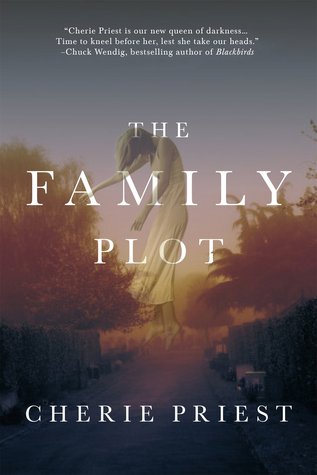
Cherie Priest, The Family Plot. Tor Books, 2016. Pp. 365. ISBN 978-0-7653-7824-8. $25.99.


I spent this past Halloween carefully reading Cherie Priest’s new novel, The Family Plot, in the daylight hours. Confession: I love ghost stories, but I also have a hyperactive imagination and am kind of a wimp, so I do my best to choose wisely when the season demands spookiness. Priest delivers the perfect kind of spookiness, familiar to everyone who has been in an old house (or any other building, for that matter) and felt sure that its past inhabitants have left something of themselves behind that is extraphysical. The action glides along smoothly, and I only ever put it down when the sunlight faded.

The Family Plot concerns two families: The Duttons, who run a family business in salvaging and make their living rescuing architectural decor and fixtures from houses prior to their demolition, and the Winthrops, an aristocratic Southern line whose final descendant is more than happy to see her expansive family estate reduced to its base parts and dispersed. Our heroine is Dahlia Dutton, whose father Chuck owns and runs Music City Salvage. Dahlia is an unconventional heroine: pushing forty, recently divorced but notably not subsumed by doubts or insecurities about it. When Augusta Winthrop comes to Chuck to sell him salvage rights to her family’s home, it looks like it will be the financial answer to a number of business problems, and Chuck doesn’t hesitate to put Dahlia, or Dahl as she is sometimes called, in charge of the job. One of the elements I particularly appreciated is that Dahl’s competence at her job is absolute, and though her crew is all-male she never once has to “prove” herself to them, nor are her abilities ever questioned. This is a small thing, but unusual in fiction (and unfortunately, in real life as well).

When they get to the Winthrop property to examine the house and its contents, there are hints that all is not as it should be, but the characters take note of them—hand and footprints that mysteriously appear and that don’t belong to any of them, odd apparitions, and so forth. Dahl and the others spend comparatively very little time trying to make sense of or justifying these incidents; eventually they all reveal to one another the odds things they have seen or experienced, and try to make sense of things. The ghosts that appear include the angry spirit of Abigail Winthrop, who may have had an illegitimate child and who disappeared mysteriously before her wedding; Hazel Winthrop, her sister, who is a benevolent spirit who more than once protects Dahl from Abigail; and the child Buddy Winthrop, who was Augusta’s father. As Dahl and her crew investigate while trying to do their work on time and on budget, they find a photo album that reveals the spirits’ identities, and a small cemetery that Augusta insists was a family Halloween joke (the Winthrops’ own family business was in monuments and stone cutting). On a hunch one of the crewmen digs into the fake cemetery, and exhumes a very real—and very old—body. At that point, Dahl accepts they have several mysteries to solve, and very little time to do it in before the ghosts physically harm one of them or the demolition crew comes in to take down the house, and its bits and pieces that could make or break the family business. Even in the face of the supernatural, one has to make a living, and Dahl is determined to do that much, at least.

In the Acknowledgement Priest credits the television show Salvage Dawgs as the inspiration for the novel; it’s a reality program that follows the company Black Dog Salvage as its crew goes to buildings slated for demolition and rescues marble fireplaces, stained glass windows, decorative old wooden doors, and other materials to be reused—the very job Dahl and her father are in. While the show never features ghosts as a practical issue to be overcome (to my knowledge), it is something that Priest’s characters recognize as a rarity, but just another part of the job. “Ghosts shouldn’t be news to you,” she tells her new crewmember, Brad, “All of us down here, we’re not just living on battlefields. We’re living on graveyards” (284). This is true not just of the American South, but everywhere humans have lived; too often fictional ghost stories overlook that until very recently, the norm was for everyone to die in their own home rather than antiseptic hospitals. And as something of a nod to the source material, at one point a character suggests they discourage the ghosts by using their phones and a camera to record their doings; after all, ghosts seldom do anything when television crews show up, and the moment adds a nice element of humor, too.

The Family Plot is a perfect ghost story, both for people who love ghost stories and for those who may be more reluctant to try the genre. It may be worthwhile to think of it as being similar to Guillermo del Toro’s 2015 film Crimson Peak, which was also about a house falling apart and filled with ghosts both helpful and harmful. It’s creepy rather than horrific (something that the marketing team for Crimson Peak at least did not understand, to the film’s box office detriment), and the emphasis is thoroughly on character and atmosphere rather than scares that startle at the first read but seem predictable and dull ever after. Though Priest has a sterling reputation as a world-builder, she’s underrated as a prose stylist; in her 2014/2015 novels Maplecroft and Chapelwood she married Lovecraftian mythos with credible historical voices, which is no mean feat, and in The Family Plot she expertly blends the American Deep South’s Gothic sensibility with the contemporary “shitty job” story beloved of television. While this is Priest’s first standalone novel in a while, I wouldn’t mind a sequel to it, whether with Dahl or the other characters.

Profile

caitri: (Default)
caitri

December 2025

S M T W T F S
 123456
78910111213
14151617181920
21 222324252627
282930 31   

Most Popular Tags

Style Credit

Expand Cut Tags

No cut tags
Page generated Jan. 5th, 2026 11:34 am
Powered by Dreamwidth Studios