Last night we went to see
Belle, a film I was very much looking forward to and was delighted to see playing in town.
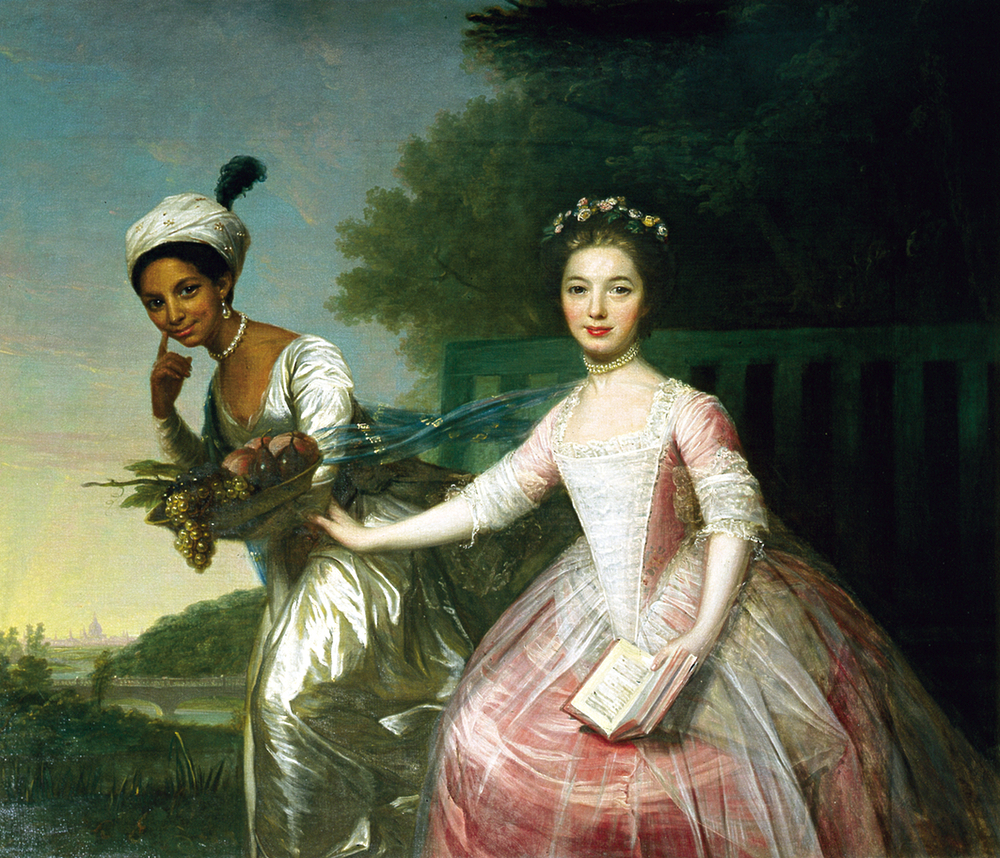

Inspired by the true story of a legitimized mixed race daughter in the upper class of 18th c. England, the film flirts at being a romance even as it touches on one of the major legal stepping stones towards the abolition of slavery. After all, a woman in possession of a fortune must also be in search of a husband who isn't an utter douchebag.
Narratively, the film walks the line of "OMG there were black people in England!!!" and "be cool, there were TOTES black people in England." It doesn't always work; there's a tell-tale opening scene when a white dude in the shitty part of town picks up our young heroine and all of the white folks make goggle eyes. Like, there's only the two black people in the scene--the young girl and her aunt--but, come ON, there was a thriving community of ~250,000 blacks in London. Much later there's a scene when Belle and her cousin Elizabeth are in London for the season and Belle is struggling with combing her hair, and the black maid shows her that it's easiest to start from the ends. Which...it seems like this is the first time Belle has ever seen another black person? And I guess she's had to comb her hair the hard way for 21 years? The ONE SCENE with more than two black people in it is the climax at the end, when there are numerous black men in the balconies of the court, and NONE of them have lines, which reminded me uncomfortably of
Django Unchained.
Newsflash, screenwriters: black people had a helluva lot to do with the abolitionist movement; it wasn't all just about white allies. JUST SAYIN'. (
Amazing Grace is guilty of this sin too.)
I thought the film did a good job with the, ah, subtleties? flavors? of various kinds of racism too. Draco Malfoy appears as, er, Draco Malfoy--seriously, I kept waiting for him to call Belle a mudblood--who has nothing but disgust for Our Heroine, while his brother is the "nice" sort who thinks Belle's a babe and would totally be down with marrying her because she's rich and "overlook" the fact that she's brown and whatnot. Those conversations reminded me of all of the "Spock and his human mother" moments in Reboot; I was a little bit surprised that Belle actually didn't say "Live long and prosper" at the end there.
One of the things the film got very close to getting right was the friendship of Belle and Elizabeth, but even that was a little odd. Elizabeth hates that Belle can't eat with the family when company is over because reasons, and she's often sympathetic, but she is also absorbed in finding herself a husband and somehow can't tell Draco is a douche. There's also a scene where Belle is trying to explain that Draco is a douche and Elizabeth accuses her of lying and it's just an ugly, unfortunate scene that didn't really work for me on any level. It felt kind of shoved in, like someone said to the writers "you need to put some character tension in" and rather than say "you don't think 18th century mores make ENOUGH tension?!" they went ahead and did this.
Another narrative weakness was that the film never quite got at what the status of race actually WAS in ca. 1780. There's a scene where Belle asks if the black maid is a slave or not, and her uncle says that she's free and under his protection. "Like me," says Belle. Maybe a British audience would have been up on the fine points on this topic, though I doubt it, and the average American audience definitely wouldn't be. Seriously, a succinct three line paragraph at the beginning could have clarified this.
In short: it's a great film that's gorgeous, has great acting, and will hopefully be useful for having better conversations on race and history, but it also totally takes all of the easy paths of storytelling, and a complex story like this needed more.
![[personal profile]](https://www.dreamwidth.org/img/silk/identity/user.png)


